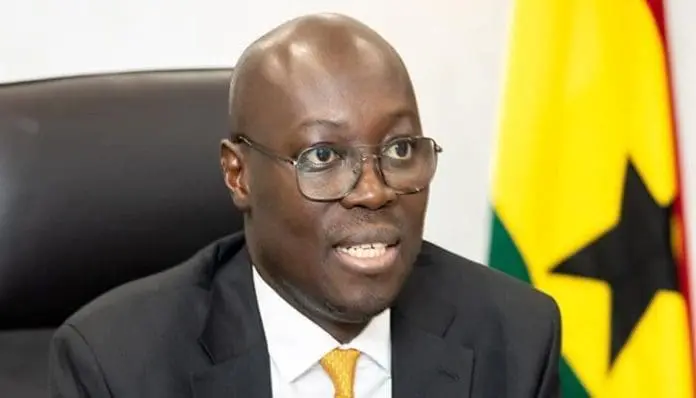
Ghana’s economic recovery will face renewed scrutiny as Finance Minister Dr Cassiel Ato Forson and other global policymakers gather in Bangkok, Thailand, for the IMF and World Bank Annual Meetings from October 12 to 18, 2026.
Although Ghana has made progress in stabilising its economy and reducing borrowing costs, inflation has increased for a second consecutive month, raising questions about how long the country can sustain its gains.
The meetings, being held at the Queen Sirikit National Convention Center, provide Ghana with an opportunity to convince international investors that its improving economic conditions can translate into greater private investment, job creation and long-term growth.
Here are the key reasons why Ghana’s economic recovery faces an important test at the meetings.
1. Inflation Has Started Rising Again
One of the main concerns is the recent increase in inflation.
According to the Ghana Statistical Service, annual inflation rose to 5.2 per cent in September from 5.0 per cent in August, marking the second consecutive monthly increase.
Food inflation also increased from 3.0 per cent to 4.0 per cent, while prices rose by 0.8 per cent over the month.
Although inflation remains significantly below the 9.4 per cent recorded a year earlier, the upward trend could complicate efforts to maintain price stability and ease the cost of living.
2. Further Interest Rate Cuts Could Be Limited
The increase in inflation could restrict the Bank of Ghana’s ability to reduce interest rates further.
The central bank has maintained its policy rate at 14 per cent since March, with the Monetary Policy Committee keeping it unchanged for the third consecutive meeting on September 24.
Meanwhile, the Ghana Reference Rate, which banks use as a benchmark for pricing loans, declined to 10.04 per cent in October from 15.68 per cent in January.
Although borrowing costs have improved significantly, a sustained rise in inflation could make further monetary easing more difficult and affect how quickly businesses gain access to cheaper credit.
3. Ghana Must Convince Private Investors to Commit Capital
With Ghana having exited its IMF bailout programme, the government wants to demonstrate that the economy can sustain its recovery and attract private investment without relying on another financial rescue.
Finance Minister Dr Cassiel Ato Forson has described the country’s transition from the IMF programme as a shift from being a “supplicant” to a “partner”.
He has also said Ghana’s economy has exceeded $100 billion in size for the first time.
The challenge now is to persuade investors that these gains create viable opportunities in manufacturing, agriculture, energy and other productive sectors.
4. Other African Economies Are Competing for Investment
Ghana will be presenting its economic prospects alongside those of other countries across Sub-Saharan Africa.
On October 6, the World Bank raised its 2026 growth forecast for the region to 4.3 per cent, revising its projections upwards for nearly three-quarters of the region’s economies.
This means Ghana is competing for investment with other African markets that are also showing improved growth prospects.
To stand out, the country will need to demonstrate that its improving economic indicators can support profitable investments and sustainable business expansion.
5. High Debt-Servicing Costs Continue to Constrain African Governments
Debt remains a major challenge across the continent, limiting the resources available for development.
World Bank chief economist for Africa Andrew Dabalen said in April that debt servicing had risen to about 18 per cent of government revenue across the region in 2025, double the level recorded in 2017.
About half of African countries were at high risk of, or already experiencing, debt distress.
High debt-servicing costs leave governments with less money to invest in infrastructure, electricity, education and other public services. This makes private investment increasingly important to financing economic development.
6. Economic Growth Is Not Automatically Improving Living Standards
Another challenge is ensuring that economic expansion translates into better incomes and living conditions.
The World Bank has projected that income per person in Sub-Saharan Africa will rise by just 1.8 per cent in 2026.
For Ghana, this underscores the importance of ensuring that economic stability supports productive businesses, creates jobs and improves household incomes rather than being reflected only in headline economic statistics.
7. Ghana Must Demonstrate That Lower Borrowing Costs Can Generate Jobs
The decline in the Ghana Reference Rate provides an encouraging sign for businesses seeking credit, but lower borrowing costs alone do not guarantee increased investment.
At the meetings, Ghana will need to demonstrate how improved macroeconomic conditions can support expansion in factories, agriculture, energy and other sectors capable of generating employment.
Investors will be looking for evidence that economic stability can translate into sustainable commercial opportunities and stronger productivity.
8. The 2027 Budget Will Be an Important Next Step
Finance Minister Dr Cassiel Ato Forson is preparing Ghana’s 2027 Budget, which he is expected to present to Parliament later this year.
The budget will provide an indication of how the government intends to maintain economic stability while supporting investment, job creation and growth.
The policy choices outlined in the budget will be important as Ghana seeks to consolidate its recovery and manage emerging inflationary pressures.
Conclusion
Ghana enters the IMF and World Bank Annual Meetings with significant progress to showcase, including lower borrowing costs and its exit from the IMF bailout programme.
However, rising inflation, competition for private investment and broader debt pressures across Africa mean the country still faces important challenges.
The key question is whether Ghana can turn its improving economic indicators into sustained investment, more jobs and tangible improvements in living standards.

