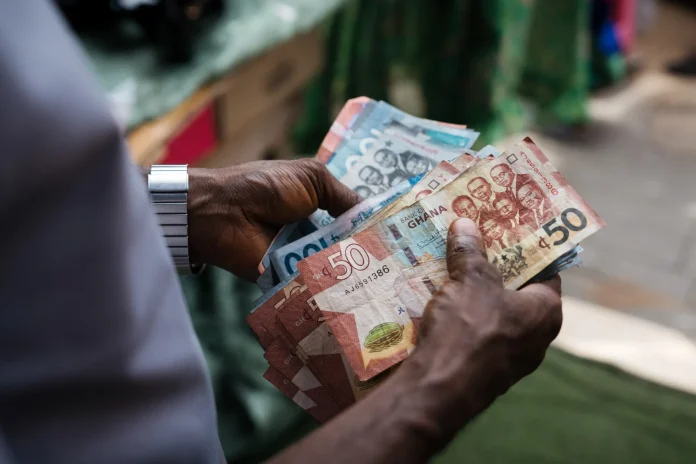
Bank lending rates in Ghana have fallen sharply over the past 26 years, declining from 47 per cent in October 2001 to 15.94 per cent in August 2026, as lower inflation, falling Treasury bill yields and changes in monetary policy have helped reduce the cost of borrowing.
However, financial experts say the next challenge is to ensure that cheaper credit translates into increased investment, business expansion and job creation, while savers also benefit from improved returns.
Data from the Bank of Ghana (BoG), analysed by data analyst Bernard Obeng Boateng, shows that the average interest rate on ordinary savings deposits also declined over the period, falling from 15.5 per cent in October 2001 to 4.10 per cent in August 2026.
The gap between lending and savings rates consequently narrowed from 31.5 percentage points to 11.84 percentage points.
Here is how Ghana’s lending rates have declined and what the changes mean for businesses, banks and savers.
1. Lower Inflation and Changes in Monetary Policy Reduced Borrowing Costs
The decline in lending rates has coincided with lower inflation and reductions in the Bank of Ghana’s monetary policy rate.
The central bank reduced its policy rate to 14 per cent in March 2026 and maintained that level through September. Meanwhile, inflation stood at 5.2 per cent in September 2026, according to the Ghana Statistical Service.
These developments have contributed to a changing interest-rate environment, creating conditions for banks to reduce the rates charged on loans.
Banking consultant Dr Richmond Atuahene explained that monetary policy influences Treasury bill yields, which in turn affect the cost of borrowing from commercial banks.
“When Treasury rates come down, bank lending rates also come under pressure to fall. The monetary policy rate influences treasury rates, which then affect the cost of borrowing from banks,” he said.
2. Falling Treasury Bill Yields Changed Banks’ Investment Incentives
The decline in government securities yields has also influenced how banks seek returns on their funds.
The 91-day Treasury bill rate fell to 5.38 per cent in August 2026, from 10.26 per cent a year earlier.
Dr Atuahene said banks had previously been able to earn returns by investing in government securities, reducing the need to seek out private-sector borrowers.
“Banks could buy government securities and make money without going out to find borrowers. Now, the system is pushing them to do proper banking and find businesses that need money,” he said.
With lower returns available on government securities, banks face greater pressure to identify viable businesses and individuals seeking financing.
3. Lending Rates Fell Faster Than Savings Rates
The narrowing gap between lending and savings rates has largely resulted from borrowing costs falling faster than the returns paid to ordinary depositors.
According to Mr Boateng, the average lending rate dropped from 20.58 per cent in January 2026 to 15.94 per cent in August, while the average savings rate remained unchanged at 4.10 per cent.
He cautioned that a narrower gap does not automatically mean banks are earning less from lending or that ordinary savers are receiving better returns.
“The cost of borrowing has fallen much faster than the return on ordinary savings. The spread is now narrower, but that does not necessarily mean banks are making the same amount of money from the difference,” he said.
Financial markets expert Norman Adu Bamfo also noted that the lending rate remained almost four times the ordinary savings rate in August 2026.
4. Lower Rates Have Created Better Borrowing Conditions for Businesses
The reduction in lending rates offers businesses the prospect of accessing credit at more affordable costs than during periods when commercial lending rates reached 28, 36 and even 40 per cent.
Dr Atuahene said lower rates could make it easier for businesses to finance operations, invest in equipment and expand production.
“If a business can borrow at 13, 14, 15 or 20 per cent, that is better than borrowing at 28, 36 or 40 per cent. But the money must go into productive activities,” he said.
However, the average lending rate does not guarantee that every borrower will obtain a loan at that rate. Actual borrowing costs depend on factors such as creditworthiness, the risk profile of the borrower and the terms of the loan.
Mr Boateng said the real measure of progress would be whether businesses could access affordable financing to increase production and invest in expansion.
5. Banks Are Being Encouraged to Lend More to Productive Sectors
Experts say lower borrowing costs alone will not guarantee stronger economic growth unless credit reaches businesses capable of increasing output and creating jobs.
Dr Atuahene observed that banks continued to finance trade and imports, while productive sectors such as agriculture received comparatively limited financing.
He argued that banks should use the changing interest-rate environment to identify viable businesses and support investments that generate economic value rather than rely heavily on government securities.
A stronger flow of credit to productive sectors could help businesses expand their operations, improve output and create employment opportunities.
6. Savers Continue to Face Low Returns
Although borrowers have benefited from lower lending rates, ordinary savers have not experienced a comparable improvement in deposit returns.
The average savings rate stood at 4.10 per cent in August 2026, while inflation reached 5.2 per cent in September.
If inflation remains above the interest earned on savings, depositors experience a negative real return, meaning their money loses purchasing power despite earning interest.
Mr Bamfo said the narrowing lending-savings gap had not benefited borrowers and savers equally. He called for greater competition and transparency in deposit pricing to ensure that savers benefit more from changing market conditions.
7. Better Credit Information and Loan Recovery Could Reduce Rates Further
Experts say sustained low inflation and fiscal discipline will be important in maintaining the downward trend in lending rates.
Mr Bamfo also identified improved credit information and faster enforcement of loan agreements as measures that could help reduce borrowing costs.
Non-performing loans remain another concern because losses from unpaid debts can increase the risks banks face and potentially lead them to charge other borrowers more.
Strengthening credit assessment, improving loan recovery and addressing inefficiencies in the banking system could help banks manage these risks and offer more competitive rates.
What Happens Next?
Ghana’s lending rates have fallen substantially since 2001, but experts say the long-term benefits will depend on how effectively the financial system channels credit into productive economic activity.
For businesses, lower rates offer an opportunity to seek financing for expansion and investment. For banks, declining returns on government securities increase the importance of identifying creditworthy private-sector borrowers. For savers, the challenge remains securing better deposit returns that protect purchasing power.
The central question is whether the decline in borrowing costs will translate into stronger production, more jobs and sustainable economic growth, while creating a more competitive banking environment for both borrowers and depositors.

