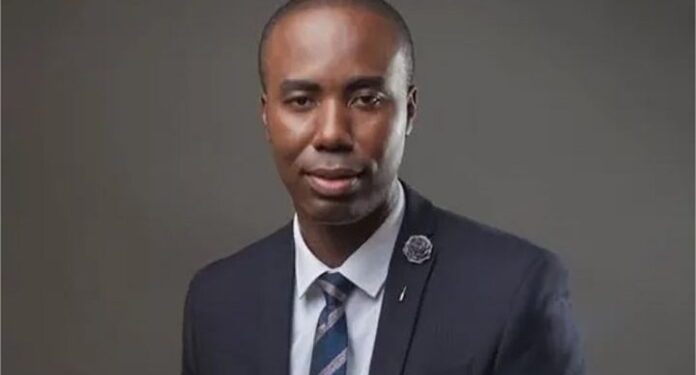
The Attorney General has filed written submissions at the High Court urging it to dismiss former National Signals Bureau (NSB) boss Kwabena Adu-Boahene’s application of no case to answer in the trial over the alleged diversion of GH¢49.1 million earmarked for the purchase of cybersecurity software for the state.
The application, filed by Adu-Boahene on September 25, 2026, followed the close of the prosecution’s case. He is asking the court to dismiss the Republic’s case against him and acquit him of the charges without requiring him to open his defence.
In a 25-page submission, the Attorney General outlines the evidence presented during the trial, arguing that it establishes the essential elements of the offences charged and provides sufficient grounds for the case to proceed.
Adu-Boahene, his wife, Angela Adjei Boateng, and a company allegedly owned by the couple, Advantage Solutions, are standing trial on 11 financial offence charges relating to the alleged diversion of GH¢49.1 million intended for the acquisition of cybersecurity software for the state. The accused persons have not been convicted of the charges.
Four witnesses presented by the prosecution
The prosecution called four witnesses before closing its case, with their testimonies addressing the movement of funds, financial transactions and investigations into the alleged diversion.
The first prosecution witness, Frank Anane Dekpey, a driver for Adu-Boahene, testified that he carried out errands on behalf of the former NSB boss, including transporting cash in “Ghana Must Go” bags for deposits and withdrawals on his instructions.
The second witness, Ruby Adumoah Opoku, Head of Finance at the NSB, testified about the transfer of GH¢49.1 million from the bureau’s account into an account she said was unknown to the institution.
The third witness, Mildred Donkor, a former employee of the accused persons, told the court that she operated a company established by them to facilitate the movement of funds. She also testified that the accused persons gave her pre-signed cheques for that purpose.
The fourth witness, Frank Marshall Cromwell, an investigator with the Economic and Organised Crime Office (EOCO), presented details of accounts allegedly created to facilitate the diversion of the funds.
His testimony also covered investigations into expenditure allegedly made for the accused persons’ private benefit and findings that challenged the authenticity of a letter purportedly confirming the purchase of the cybersecurity software.
Attorney General says evidence establishes the charges
In its written submission, the Attorney General argues that the prosecution’s evidence, considered alongside the applicable law, sufficiently establishes the essential elements of the offences charged.
“The above analyses of the law on the offences charged and the evidence adduced in Court shows that the Republic has supplied to the Court sufficient evidence to prove each of the essential ingredients of each of the offences charged. The evidence which the Republic adduced did not leave any of the allegations in equivocation. They all point decisively to guilt,” the Attorney General stated.
The prosecution also contends that the cross-examination of its witnesses by the defence did not materially undermine the central evidence presented to the court.
Describing the cross-examination as “extraordinarily tangential”, the Attorney General maintains that the defence focused on peripheral issues rather than challenging the substance of the prosecution’s documentary evidence.
Citing the cross-examination of the third prosecution witness, Mildred Donkor, the Attorney General argued in paragraph 60 of the submission:
“The cross-examination of PW3 did not disturb the substance of her evidence on the transfers at all. It was rather directed at collateral matters including the lawyers present at her interrogation by EOCO, her salary, and A3’s pension payments (which this Court rejected as irrelevant – R4 and R5).”
On the strength of these arguments, the Attorney General has asked the court to dismiss the accused persons’ submission of no case to answer.
Court to rule on November 5
With the relevant submissions filed by both the accused persons and the Republic, the High Court is scheduled to deliver its ruling on Thursday, November 5, 2026.
The ruling will determine whether the accused persons are acquitted at this stage or whether the prosecution has presented sufficient evidence to require them to open their defence, should they choose to do so.
The decision will mark a significant stage in the trial, determining whether the case proceeds to the defence stage or ends without the accused persons being called upon to answer the charges.

